



Gavin Harris is a Research Intern and Govind (Vinny) Pimpale is a Research Fellow on the Super Intelligence team at the Foundation for American Innovation.
Anthropic released its S-1 last Monday. While many of the exact financial details are still left out, what we do have is still quite interesting and gives us a much better look at the governance and compute commitments of one of the most successful AI firms. Anthropic’s governance and compute decisions make the most sense if the firm is organized around the expectation of an AI singularity.
In the short term, readers should watch for the vacant seat on the board and the compute totals Anthropic left blank in the S-1. In the long term, changes to the Founders LLC and Trust could signal dramatic change in the company’s vision, and how Anthropic chooses to cancel or fulfill its less binding contracts will hint at changes in AI infrastructure supply.
Anthropic’s Corporate Governance Structure
Anthropic’s S-1 lays out its corporate governance structure in detail. In broad strokes, the founders maintain an extremely high level of control over the company, and general stockholders have almost no say over Anthropic’s internal affairs. The LTBT is also influential, but not sovereign.
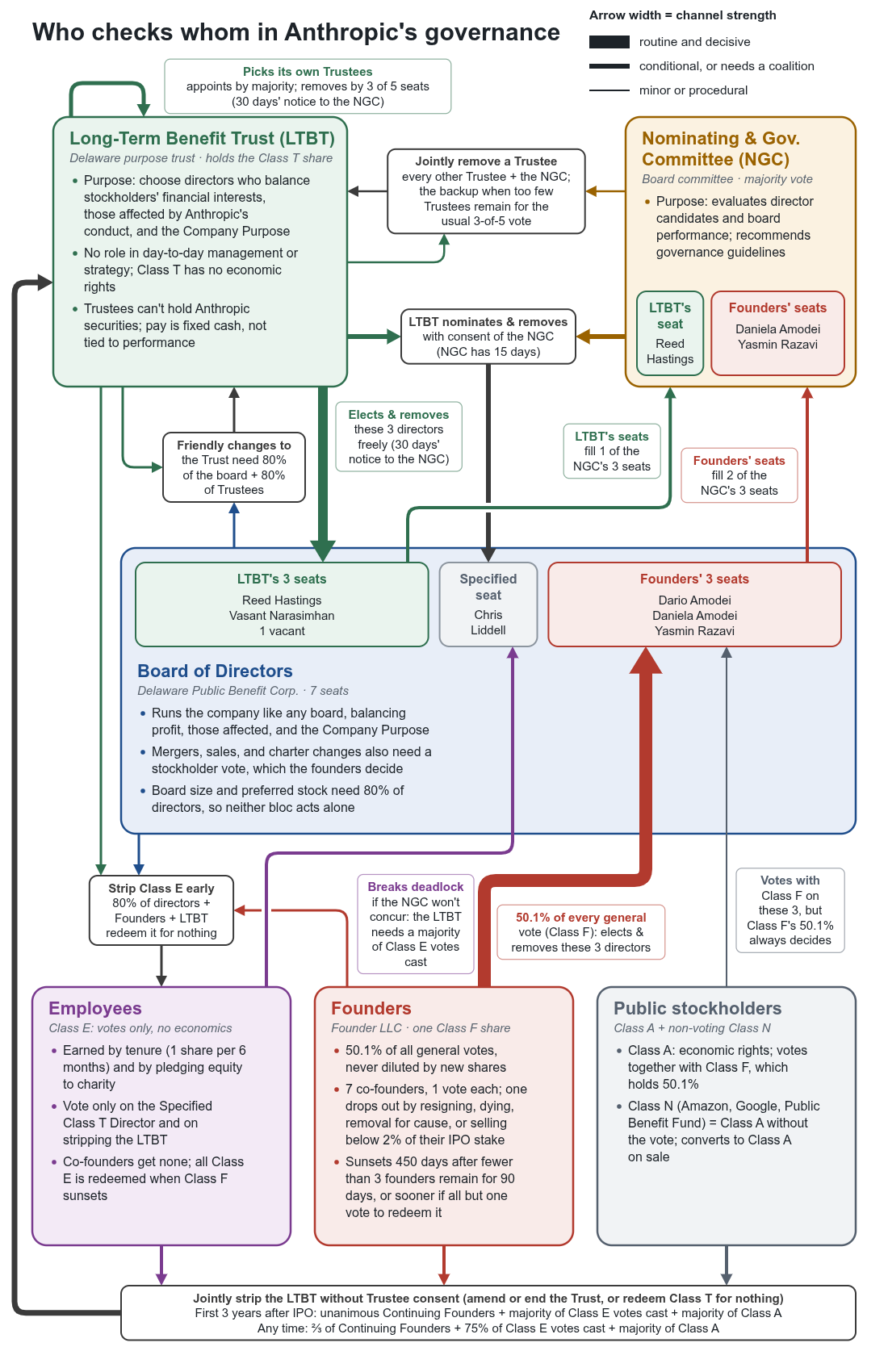
Today (but not necessarily forever, as we’ll see), there are four main governance bodies in Anthropic:
The Board of Directors makes all decisions regarding the company’s business and affairs just like other companies.
There are exceptions: major actions, such as a merger or a charter change, also need a stockholder vote (which the founders control).
The Nominating and Corporate Governance Committee (NGC) is a three-member subset of the Board of Directors, containing two members elected through the founder-controlled vote and one LTBT-appointed member.
The LTBT is responsible for choosing 4/7 of the Board of Directors altogether. 3/7 of these seats are chosen by the LTBT alone. The last seat requires either the consent of the NGC or a majority vote of the employees.
The Founder LLC maintains 50.1 percent of the vote on general matters. This enables it to effectively make unilateral stockholder decisions. Thus, its approval is needed for any sales, mergers, or charter changes. It also gets to appoint 3/7 of the board seats (the stockholder-controlled ones).
The Employees have special voting (Class E) stocks. Employees with a longer tenure or who have pledged shares to charity get more stocks. They serve as the deciding vote on the final LTBT-appointed seat if the NGC does not give consent to the LTBT’s decision. Their vote is also required to terminate the LTBT together with the founders and Class A shareholders.
These rules by and large decide the composition of the board. However, the charter enables supermajorities of two or more bodies to jointly disempower another.
First, the LTBT can be amended or its share cancelled without the trustees’ consent: within three years of the IPO by all of the founders plus majorities of employee and common stockholder votes, and at any time by two-thirds of the founders plus 75 percent of employee votes and a common stockholder majority.the LTBT can be amended or terminated by a combination of the employees (majority vote), the founders (unanimous), and the common stockholders (majority). This is one of the few powers that common stockholders get. If the LTBT were terminated, the founders would likely control the entire board.After termination of the LTBT, the founders get to appoint the entire board. Second, the employees’ ability to vote can also be stripped permanently by 80 percent of the Board of Directors, the founders, and the LTBT. Finally, a supermajority of founders can remove their own power by triggering a process called Class F Sunset.
This last provision - Class F Sunset - can also trigger automatically if the LLC has fewer than three co-founders or successors for 90 consecutive days. There are two cases:
Before the 10-year IPO anniversary: a founder who dies or becomes incapacitated may be replaced by a successor (selected from a confidential list), but importantly not if they resign or are fired for cause.
After the 10-year IPO anniversary: only original founders count; successors due to death or incapacity no longer count towards the three-member minimum.
Anthropic’s founder succession rules show how much the founders trust their own judgment. Each founder pre-picks a ranked list of ten successors. The Founder LLC succession lists must be approved by a supermajority of the other founders. The board must notify the NGC, and then the lists are kept secret from everyone else. Successors must meet various requirements, including being a current or former Anthropic employee, or working at a nonprofit or an organization whose primary purpose is research, education or public benefit. Founders are also able to take qualifying leave roles in government or another nonprofit organization.
Once the Class F Sunset occurs, the employees lose their ability to vote. Additionally, the board ceases being reelected annually and instead switches to a staggered structure where directors serve three-year terms, and only a third of the board of directors are re-elected each year. These and other governance changes suggest that the founders intend the termination of Class F to be the beginning of a transition to a “normal technology company.”
The Compute Implications
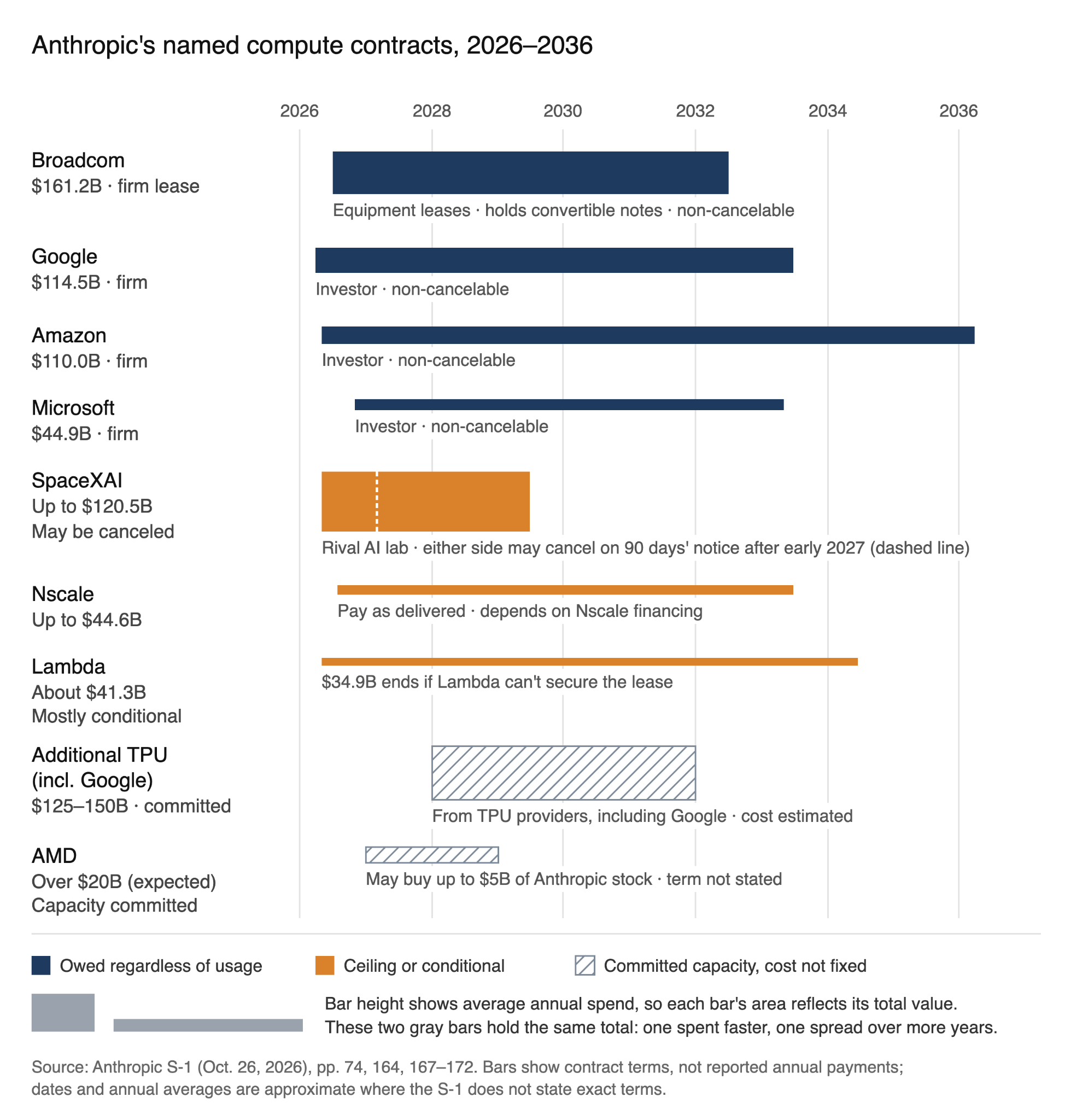
Anthropic has entered into massive contractual agreements with rivals, suppliers, and investors alike for compute capacity. By our count, Anthropic’s named contracts for compute infrastructure could total $807 billion extending as far as 2036. The S-1 also notes that Anthropic has entered into other compute arrangements outside of the named $807 billion. The true total is higher. Anthropic also says that its commitments extend as far as 2045, a remarkably long timeline for a technology company.
In comparison to some other famous IPOs, these numbers look absolutely gigantic. Facebook’s 2012 IPO included a section on commitments, which is thematically similar to Anthropic’s compute commitments. At the time of its IPO, Facebook stated that its total contractual commitments were around $2.26 billion up to 2027. Anthropic’s named contracts over roughly the next decade are about 357 times Facebook’s total commitments over 15 years.
In comparison with its own contracted revenue, its commitments are again hard to understand without context. As of June 30th, Anthropic had only contracted $10.8B of its future revenue, which is around 80x less than its contracted commitments. This seems as if it would be a problem, if its liabilities so heavily outweigh its assets. Anthropic’s cash on hand and short-term investments covers about a sixth of its commitments, but that is still a large gap.
One especially interesting contract is the SpaceXAI contract. SpaceX and Anthropic have had a tumultuous relationship, but the S-1 filing discloses that the relationship now has a contract undergirding it with a ceiling of $120.5 billion – almost a sixth of Anthropic’s named contracts in the S-1. The potential commitment is huge, but the nature of the relationship demands the clause which enables either party to back out on 90 days’ notice after early 2027. One thing to keep an eye out for is the cancellation (or continuation) of this contract. Data centers may be moving to the final frontier in the near future. Continued goodwill between SpaceX and Anthropic through contractual agreements could support the advent of supercomputing in space.
The S-1 still leaves numbers out related to its total contractual commitments, so that will be something to watch out for in the coming months. We calculated our maximum total by adding all the named contracts, even those that are usage-based or cancelable, along with AMD’s expected spend and the top of the estimated additional TPU range. Anthropic leaves the spaces to total its commitments, named and unnamed, blank. It is expected that Anthropic will release an amended filing before its IPO – leaving the spaces blank indicates that they will fill them in the future.
Singularity-oriented Strategy
It’s no secret that the Anthropic founders believe that a singularity in which AI is able to automate its own improvement and accelerate progress beyond human control is coming, and soon. Jack Clark, Anthropic cofounder and current Head of Public Benefit, has stated that he believes Recursive Self-Improvement (RSI) could begin in 2027. The S-1 discloses that Claude wrote over 90 percent of contributions to Anthropic’s codebase in September 2026. The remaining gap to 100 percent may close quickly, especially as the creativity and problem-solving ability of frontier models improves rapidly.
When viewed from this light, many of the initially mystifying decisions enumerated in the S-1 become clearer.
Take succession. If a founder dies or becomes incapacitated, the Founder LLC can choose a successor, but only for 10 years after the IPO. After that, successors lose their seats and only the original co-founders count toward the three-member minimum that keeps founder control alive. One plausible reading is that the founders expect a singularity to occur within the next decade. If it hasn’t arrived by then, perhaps a standard corporate governance structure would be better for the company.
One of the more mysterious questions is why the removal of the employee voting powers is relatively easy. If 80 percent of the board, the Founder LLC, and the Trust agree, Anthropic’s employees can lose their voting shares entirely, without a vote by the public or the employees. In contrast, amending the Trust without the trustees requires the founders plus majorities of both employee and public votes. One possible explanation is that Anthropic expects the relevance and composition of its workforce to change rapidly after RSI, and wants to keep its options open for that reason.
Another question is why Anthropic has chosen to commit itself to its particular balance of non-cancelable contracts and cancelable or usage-based contracts laid out in the S-1 (roughly half and half). In the singularity context, it seems that this balance commits Anthropic to building the frontier, while also providing itself enough flexibility to avoid failure until the singularity arrives. $807 billion is an extraordinary sum, hard to justify unless you accept Anthropic’s premise that AI is and will be utterly transformative.
Conclusion
Anthropic’s S-1 shows a company built around the expectation of RSI. Its governance concentrates decision-making capability in the hands of its founders, checks their influence with the Long-Term Benefit Trust, and lets the most powerful bodies rewrite the rules if they need to, often without asking employees or public shareholders. Its compute commitments total more than $800 billion in named contracts and stretch to 2045, which are liabilities and timelines unlike anything a company has brought to the public markets before. They far exceed the revenue it has under contract.
If the founders are right about RSI, flexible governance concentrated in the hands of the few may be necessary to steer the company at the pace of progress. Enormous compute bets now may be necessary to deal with the anticipated demand growth in the near future, on the bet that more capable AI will eventually bring down the cost of compute. As Anthropic moves from private lab to public company, policymakers should look past its growth figures to the governance and infrastructure commitments that may still change before its IPO.